 Goffys '59 A10
Goffys '59 A10
Not Tonight Josephine...!
Originally written 2002, this has been updated Feb. 2004 , Oct '05 & Apr'06 with additions in italics
| I bought this A10 from a chap called Paul Philips in Chalfont St. Giles in 1977. She was dismantled then but in fairly large bits, so I reassembled her with a respray in something like Golden Flash beige. All the tin ware was there so it went back more or less original. The speedo was missing as was the carb., so I fitted a concentric that I had laying around and as it ran so well it was eventually replaced with another, although larger 30 mm version. The crank was on standard grind and the bores were also standard so it must have been a fairly low mileage bike and so promised a few trouble free miles. I’d just sold my plunger A10 that had been pulling a sidecar for some time, so with the help of some scrounged fittings she became a combo. | 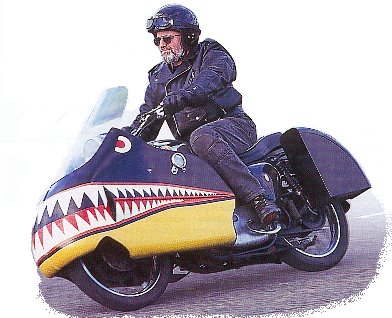 |
Common knowledge has it that cheap cars killed off outfits in the early 1960s but by the mid 70s cars were still too expensive for many impoverished youngsters so cheap old British bikes were the way to go with a second pulling a chair to carry the washing, shopping and broken-down or non-running bikes. I had a Dommie Café racer with a single seat so something to carry the girlfriend as well was needed. One of my friends had an Ariel outfit, another an A10 and another made a living as a window cleaner around Marlow with a double adult sidecar on an M21.
I ran Josephine far about 3 years as an outfit and did thousands of miles all over the country on club runs with the Bracknell Lepers carrying all the camping gear, spare petrol and tools. She was very reliable and I can only remember 1 breakdown, in Salisbury when the clutch fell off the end of the mainshaft - which was my fault for not putting it on properly in the first place, without a tab washer.
After the first winter I had to have a rebore done, as she was becoming very oily and smoky. I was disappointed to have to have it taken out to +30 as it wouldn’t clear on any less. I had no idea of the mileage, as there was still no working speedo, but one winter didn’t seem enough to wear out a top end. A clue was a persistent freezing carburettor whenever it was cold and wet; eventually I discovered that the rear wheel was throwing water and muck through a hole in the mudguard, past where the battery would have originally been (now in the sidecar) and straight into the bellmouth on the carb.! A filter was fitted and I have so equipped every other bike I’ve owned. Fork bushes and wheel bearings were frequently needed so I had a spare set of forks and a rear wheel that I would rebuild ready for when they would be needed. Every fortnight or so I would have to reset all the sidecar mounts and chains and sprockets didn’t last too long either. If I had ridden around gently all this heavy maintenance wouldn’t have been necessary, but I was often having to keep up with solos so she given a bit of stick.
I was getting tired of being cold and wet in the winter so a Reliant van was bought. Just like Del Boys but red, so off came the sidecar and despite having had to weld a cracked downtube below the headstock where a fitting had come loose in the past she still handled perfectly. By this time I had a Commando as well so Josephine was relegated to being a working hack and winter bike.
After the clutch fell off I fitted a Plunger A10 clutch which as well as being much stronger had a duplex chain, which made maintenance much less frequent. Always valuable on an outfit as the clutch is on the same side as the chair (for those brought up on Jap bikes and still reading), or in my case wooden box. This has the unfortunate effect of lowering the gearing from standard and alternative sized engine sprockets were not available for plunger A10s. I tried a larger gearbox sprocket but as the gearbox was running slower the change suffered.
That was eventually changed for a Norton clutch which although only having a single row chain had an extra cush drive and allowed for the easy changing of gear ratios. It is now on 22 teeth on the engine; that is 1 tooth more than std. and with the Norton clutch being 1 tooth less raises the gearing substantially. This obviously slows the acceleration some but with the benefit of the fairing allows comfortable cruising at 75-80 mph. I'll drop it back down to 21 at the next rebuild as I don't do too many long distance rides on the A10 any more. The Norton clutch is bullet proof and I haven't needed to look at it since it went on.
The Dustbin fairing I picked up at Kempton Park autojumble for £20 and, although it had no fittings, was in good condition apart from a hole in the front about big boot size. I’ve mounted it using bonded rubber mountings, which isolates it from the engine vibration so it isn’t at all noisy. The down side is that the mounts allow flexing that has caused the gel coat to crack. Really gusty side winds can be interesting but generally it is a great improvement on when the bike was unfaired. Prejudice against fairings I can’t understand. Fit a well-designed fairing and the bike will be faster, use less petrol, and you will stay warmer and dryer. Also every post 1950s racing bike I’ve seen has a fairing so they cannot be accused of having no macho appeal. It makes the bike much bigger so takes up more space in the garage and the lock has had to be reduced so manouevering is more difficult. But the advantages outweigh the disadvantages, particularly staying dry.
I run a cartridge oil filter in the return line and use 20/50 and it is still on std. big ends having had 1 grind to 10 thou on the bush. The last bottom end rebuild was 1996 when I fitted new shells and had a new bush milled to suit the crank. That was 30,000 miles ago (I’ve got a speedo now!) and all is well for a couple of more years at least. That was the second bottom end rebuild, the first was so long ago I can't remember when, but I do know that the total engine rebuild cost £80.00. You can’t even get the pistons for that now.
I thought the ends were going in June 1998, but that turned out to be worn splines on the crank, which make an annoying noise but won’t affect the reliability.
An annoying rattle, especially when cold was a small end wearing out, which was replaced in 1997, and apart from the usual servicing no other engine work has been needed. At the same time as the small end I fitted an alloy head from a Road Rocket and opened the port out to 30 MMNov. 1998 I started using Premium unleaded mainly to save money and also to find out if the prophets of doom were right after all about valve seat recession. All was fine for 3 months or so when I was using the bike mainly for daily trips to work and other short journeys. April 1999 I went to a rally in Portsmouth (about 80 motorway miles away) and as usual I was late setting off so the journey down was at 70-80 MPH.We had a good fast ride to Poole & back, (particularly on the way back as we got lost and managed to turn a 20 mile journey into 50) with some more modern machinery. The trip home was done at speed also as this was the day of the second K-Tec failure and by the time it was half way home it was getting dark and p-----g down with rain. Around Guildford, the engine started popping and banging in the exhaust, the exhaust pipes had turned blue and there was very little compression on either side. These are the classic symptoms of the valve clearences closing up due to valve seat recession... After resetting the tappets when I got home I started using Redline Lead substitute.
After a couple of years of this the compression gradually disappeared again, and on dismantling I was surprised to find the valve seats OK but the valves burnt out. I had SRM fit bigger inlet valves, gas flow the head and hardened exhaust seats just in case. With hindsight I probably had either poor quality pattern exhaust valves or more likely inlet valves incorrectly fitted on the exhaust side.
The gearbox has had one major rebuild using a replacement cluster from a C12 which is identical but unlikely to be worn out given the low power and one minor.
The rest of the bike new Koni shocks, taper roller headraces and that’s about it. Several sets of fork bushes have been recently bought but none have proved to be accurately enough machined. I've a mixture of 2 sets fitted now with the outsides of the upper bushes tinned with plumbers solder to give a good fit in the sliders. A new set of stanchions were also bought at an autojumble but were promptly binned for the same reason.
However, the electrics are another story. As standard she ran
6V lights faultlessly for years (only one dynamo rebuild being needed) - the
problems started when I first tried to convert her to 12V using a JG conversions
unit in the late 1980s. This never kept the battery fully charged and burnt
out the dynamo so I retreated to 6V for several more years. However brighter
car headlights and ever-dimmer eyesight forced me to try again. The first K-Tek
unit lasted a couple of months and then failed open circuit. The next didn’t
last as long but failed in full charge mode, blowing all the bulbs 80 miles
from home...hence the title of this article. I eventually fitted a unit from
Al Osborne and a bloody great battery in the pannier and all is well. Also recently
fitted has been a toothed belt drive to the dynamo which has the added benefit
of speeding it up, so with the raised overall gearing the dynamo revs at any
given speed are probably about the same as standard. The
dynamo belts last only 2000 miles or so, which is a bit of a pain.
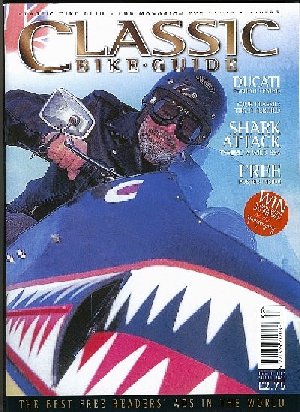
Josephine was featured on the cover of the March 2000 edition of Classic Bike Guide and given a glowing write up by staff writer Steve Wilson - I think he was particularly impressed/amused by the shark's tooth design copied from a photo of an American WW11 Curtiss P40 fighter plane. Pictures of it have been seen in Back Street Heroes and other sundry rally features but this was the only time it's had a full article written about it. Fame and Fortune beckons!
Josephine is the most reliable bike any one could ask for. She starts first or second kick, doesn’t use much oil, does 60 mpg, handles well, stops OK (Triumph 2LS front brake) comfortable on a long run and keeps me warm and dry. What more could one ask for?
Age is beginning to take its toll on Josephene as much as me, and apart from special events stays in the garage. I've got a new cluster for the gearbox, which is all it really needs. I think I'll go back to a 28MM carb as although she's got plenty of power at higher revs she's a bit flat lower down. This combined with lowering the gearing will make it more suitable for squrting around the lanes near where I live.
Oct 2004 Now pressed into use as a winter bike once more. Covered in grease, she's loving it.
Same again Oct. 2005
I used to use Josephine to commute 25 miles a day most days during the summers until 2002, and it was still a practical proposition to use an old bike. A large proportion of Britains workforce went to work on bikes in the 1950/60s and they made it most days. If you build these old things carefully they can be reliable and repay you with lots of fun.
I work from home now, so keeping Josephene in tip top condition isn't as important, but I'll fix her up soon.( Read, one day)
Apr.2006 This winters use has seen the poor old girl becoming rather sad. The cycle parts need looking at and the performance has seriously deteriorated. She's in the back of the garage again but it's her 50th birthday soon so she will have to be revived for that.
 LED Bulb replacements for car & motorcycles 6V/12V
 |
|
Brighter Quartz Halogen car & motorcycle bulbs |
|
Brighter headlamp bulbs for
modern vehicles |
|
Standard replacement car/motorcycle
bulbs |
|
Motorcycle batteries |
|
Motorcycle & Car lighting |
|
Motorcycle electrics |
|
Motorcycle accessories |
|
Motorcycle oil Filter Kits |
|
Speedometers and rev counters |
|
Handlebar levers for Classic
Bikes |
|
Filter Plus oil filter magnet |
|
Replica Girling motorcycle
shock absorbers |
|
BSA fork upgrade kit |
|
Stainless Steel Silencer Clamps |
|
Order Page |
|
Goffys Norbsa 850 |
|
|
P.R.Goff 62
Clare Rd. Prestwood Bucks. HP16 0NU
Telephone: 01494 868218 or mail me here Goffy
